High-stakes hearing


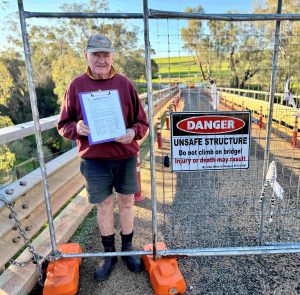
Photo: Tony Maddox was flanked by supporters
Central Wheatbelt MLA
L
achlan Hunter and former
Pastoralists and Graziers Association of
WA president Tony Seabrook at the
Supreme Court last month.

By Rashelle Predovnik

The strain of a court case that has rammifications for property owners across the state was visible on Tony Maddox’s face when he prepared to step into the Supreme Court last month with his supporters.
High profile barrister and former state Attorney General Christian Porter is representing the Toodyay farmer in the Supreme Court where Mr Maddox is launching an appeal after being charged for breaching a new rule in the Aboriginal Heritage Act he said no one was told about.
He is appealing against – what he says was a flawed process – that found him guilty of breaching the Act when he built a concrete crossing on his property.
He is also pinning his case on a section of the Aboriginal Heritage Act that protects people who did not know – and could not have reasonably known – about changes to the Act that makes their land a protected site.
The marathon hearing went for the whole day before the judge asked both parties to come back again with more information and a future hearing date is yet to be set.

Supporters back a fight they say needs to be won to protect WA landowners:

To date, Mr Maddox’s legal costs amount to more than $140,000 and the public have been generous with their donations to his fighting fund.
If Mr Maddox’s appeal is unsuccessful he will consider taking his fight to the High Court.
Supporters who fronted up to court last month included Toodyay residents who have been supporting him every step of the way.
He was also flanked by Central Wheatbelt MLA Lachlan Hunter and former Pastoralists and Graziers Association (PGA) president Tony Seabrook who are standing alongside him in a fight they say needs to be won.
Mr Hunter said he was standing with Mr Maddox to support fair, common sense protections for WA landowners.
He said the fight was one that should concern every single landowner and every single primary producer in the state.
The amendment to the Aboriginal Heritage Act that captured Mr Maddox was added in November 2023.
Mr Hunter said if Mr Maddox could be convicted under these laws, without even knowing those laws applied to his land, then everyone should be concerned.
“It’s a basic principle,” he said.
“If it’s your land, you should have the right
to manage it with clarity and confidence.”
Mr Hunter said the state’s cultural heritage laws were causing confusion and uncertainty
across regional communities.
Mr Seabrook said Mr Maddox was a brave man.
“Tony said, if he pleads guilty – he pleads guilty for every single landholder in Western Australia who has a gully on their farm and might have built a crossing,” Mr Seabrook said.
“So you can have a piece of freehold land, with a title that says its freehold land, they
[the Department of Planning Lands and Heritage (DPLH) have drawn a line on it and they haven’t even told you about it.”

The Maddox case sparks calls for state laws to change:

Western Australia’s peak agricultural bodies are now demanding the State Government makes immediate changes to the law to ensure existing and new Aboriginal heritage sites are shown on the Certificate of Title for all properties.
The call has come in response to the Mr Maddox’s appeal in the Supreme Court.
WA Farmers President Steve McGuire said the DPLH register of Aboriginal Heritage had  more than 15,000 entries, many of which were on private property.
“The Aboriginal Cultural Heritage Committee (ACHC) meets every two weeks and regularly adds new sites to the register without notifying property owners that they have a new encumbrance on their land,” Mr McGuire said.
“What we learned from the Tony Maddox case is that the DPLH doesn’t always write
to property owners when their land is being considered for a new site, doesn’t publish the
agenda or minutes of the ACHC and doesn’t notify anyone when a new site is declared.
“The fact is, there are many property owners who simply don’t know it is illegal to do
a number of things on their land because they’ve never been told it is a declared site.”
Mr Seabrook said the laws needed to change.
“Right now it is an offence if your dog or livestock enters the boundary of a registered
site – even if it’s on your property,” he said.
“Other regulations say you need ministerial approval to disturb the surface of the ground,
dig a hole, cut your grass or remove any part of a tree that you own, even if it’s dead.
Mr Seabrook said the Tony Maddox case proved having a registered site on your land
was a liability.
“It is astonishing that someone can buy land in WA and not be forewarned that the property comes with the encumbrance of containing a registered Aboriginal heritage
site,” he said.
“The government must ensure registered sites appear on the Certificate of Title so
buyers can understand the risks of the property they are considering.”

Recording a fail: what the Shire of Toodyay’s electors meeting really revealed

OPINION

Transparency in local government shouldn’t be controversial and in 2026 it shouldn’t even be a question.
Yet at the annual meeting of electors, residents had front row seats to an argument between the chair and a resident about what was or wasn’t said at last year’s meeting.
The reason?
There was no recording.

If it matters record it and make that information easy to find:

From January 2025, shires have been required to record their council meetings, and this helps to create an accurate public record, including a record of what the shire does well.
At this elector’s meeting, the manager of finance delivered an interesting presentation that outlined issues the shire had identified and fixed.
He talked about the money saved, in what was a positive story about the responsible management of public funds.
Yet there is no record of that presentation on the shire’s website.
When The Herald asked for those details so our readers could be informed about those savings, the shire president told us to find it ourselves.
He said, “the executive manager provided examples in his presentation at the annual electors meeting, all of which are documented in previous minutes of ordinary council meetings.”
That response may have technically answered the question – but does directing our readers to trawl through a year’s worth of old minutes really serve the public interest?
The information we asked for was already available in a document that could have easily been emailed.
Instead, we were told to comb through the archives of past council minutes without dates, page numbers or agenda references – to reconstruct what the shire had already presented on PowerPoint slides.
Transparency should not require detective work.

Hit record for the record:

In this case, recording matters because public meetings are not private conversations – they are part of the official democratic record.
The shire’s website notes there is no legal requirement to record the annual meeting of electors and although that is technically true – it misses the point.
Good governance is about doing more than the bare legal minimum.
Recording this annual elector meeting didn’t require a new policy, new equipment or extra funding.
It just required the shire to wheel out the same recording equipment it uses for council meetings or even a mobile phone at a push.
Instead, the room was left listening to two conflicting versions of the same event with no ability to review a recording.
And this incident summed up a broader problem on display that night.

An open forum with the floor closed:

The annual meeting of electors is a forum for residents to ask questions, raise motions, and discuss general business.
Apart from this editor, only ten ratepayers attended and only two questions were submitted to the shire in advance.
No motions were raised or voted on, and no questions were asked about the annual report.
So, there was time and there was space.
Yet when a ratepayer tried to ask questions from the floor, she was told she couldn’t, because her questions needed to be sent in before the meeting.
Instead of allowing her questions to be heard – and answered or taken on notice – time was spent reading out legislative provisions explaining why they could not be asked from the floor.
Ironically, it would have taken less time to hear her questions.
When the shire president formally closed the meeting after 20 minutes, he then chose to speak to those remaining in the room.
Unsurprisingly, the ratepayer who was not allowed to ask questions chose not to stay and listen.
If you deny someone the right to be heard, they will naturally disengage.
Democracy can be messy: questions can be repetitive, they can be uncomfortable and they can test patience.
But respectful leadership requires a tolerance for scrutiny – especially at a meeting designed to give ratepayers a voice.
Toodyay residents are capable of forming their own views, but what they saw at this meeting appeared to focus more on procedure than participation.
Ratepayers deserve genuine engagement and they deserve respect.
At the very least, they deserve a meeting where someone presses ‘record’.

By Rashelle Predovnik

Community out of pocket after $195,000 lost in unclaimed GST


An internal investigation is now
underway after council rejected a request by
the Toodyay Shire administration to write off
$195,000 in unclaimed GST owed to the shire
by the Australian Taxation Office (ATO).
Council instead voted to support a
recommendation by the Audit and Risk
Committee to do more investigation and get
external advice.
The request to write off the funds as a loss
was made because a four-year window open to claim the money has now closed.

Community cost

In response to questions asked at the December council meeting, the shire confirmed the loss would decrease the available funds which it would otherwise use to deliver services to the community.

          “The community will have to bear the brunt of this in the 2025/26 year

    by reducing the amount of funds available for much needed community projects.”

A report to the Audit and Risk Committee said, as part of council’s standard end of year procedure, a reconciliation should have been done to ensure that all monies owed to the shire by the ATO in the form of GST credits had been claimed.
“And if not, lodge revised Business Activity Statements (BAS) to ensure those monies are claimed and received by theshire,” the report said.
But an investigation found that no reconciliation of GST had occurred.
Records also showed a large amount of money held by the Australian Tax Office that was owed to the shire in the form of GST credits for purchases made by the shire.
“The reconciliation showed that $633,000 was owed to the shire by the ATO dating back to 2020.”
The report said under the ATO rules, the shire was only able to amend BAS returns dating back four years.
Funds owed from before December 2021 cannot be claimed by the shire and this equates to $195,000.
The report also noted that this credit should have been picked up by management when preparing the annual financial statements each year, but there was no evidence that
this had happened.

One mistake spans two shire administrations

The historic failure to identify the money owed by December 2024 spanned successive shire administrations, including the current one.
Toodyay Shire chief executive officer Aaron Bowman told The Herald the matter was not brought to his attention by the then executive manager of corporate and community.
Mr Bowman said the issue only came to light when the current executive manager of finance and corporate services completed the year end GST reconciliation, at which point it
was formally reported to him.
The Herald questioned why the opportunity to retrieve some of the GST up until December 2025 had not been taken.
Mr Bowman said as the matter was only raised with him towards the latter part of 2025 the opportunity to act earlier had already passed.
“Additionally, the year end reconciliation process required significant time to complete, which further restricted the window for recovering any remaining GST,” he said

Wheatbelt Corella cull ruffles feathers


FLOCKS of corellas that once blanketed Toodyay’s landscape have been decimated in a coordinated cull, despite a last-ditch attempt by the Animal Justice Party to stop the mass shootings.
The cull coordinated by the Wheatbelt Natural Resource Management (WNRM) was done in partnership with the shires of Toodyay, Northam, York, Goomalling and Victoria Plains.

Cull slammed as rushed and cruel

But the program and the short notice given to the community has come under fire from Animal Justice Party WA MP Amanda Dorn who slammed the cull as cruel, rushed and ethically indefensible.
She said two out of the three species present in the region – the Western Corella and the Little Corella – were native to Western Australia.
“Both have expanded their range largely due to agricultural clearing and altered landscapes.”
“We have taken their land for farming, removed trees, altered water sources and changed landscapes, and now we plan to kill them for trying to survive in the environment we reshaped.
“Killing birds for responding to those conditions is not responsible environmental management.”
Ms Dorn said most significantly, public notice of the cull was posted on 17 February, just days before the scheduled killing.
“That is not meaningful community consultation,” she said.
“This is a major wildlife cull involving native species, yet residents have been given only days’ notice and limited information.”

Calls for more information and more options

Ms Dorn said Corellas flocked together and lethal programs risked harming many native birds indiscriminately.
“If culling is being described as a last resort, the public deserves clear evidence that alternatives were genuinely implemented and assessed.”
Ms Dorn said she acknowledged local governments had cited hefty infrastructure damage costs.
But she said if infrastructure was vulnerable, why hadn’t investment been made into infrastructure solutions?
“Modification, adaptation and habitat management are more ethical and often more sustainable than repeated lethal programs.”
The Animal Justice Party WA has called for the full public release of impact assessments and operational details and transparent reporting of proposed kill numbers as well as independent animal welfare oversight.

Cull was a necessary says Wheatbelt Natural Resource Management

WNRM chief executive officer Renata Paliskis said wildlife management decisions were complex and she understood they could evoke strong and legitimate community perspectives.
Ms Paliskis said the Corella management project had been underway for several years in response to significant and escalating impacts associated with large Corella populations across parts of the Wheatbelt.
“These impacts include serious threats to biodiversity, displacement of other species such as the critically endangered and rapidly declining population of Carnaby’s Cockatoo chicks from nesting sites, and damage to agricultural infrastructure.”
Ms Paliskis said non-lethal methods used by local shires in the past included gas-guns, bendy men, scare tactics and drones.
But these methods didn’t work as the Corellas quickly become use to them and other humane methods were being explored.
Ms Paliskis acknowledged that community expectations regarding humane treatment of wildlife was evolving and she said ongoing scrutiny and improvement of the practice was appropriate.
Ms Paliskis also acknowledged the concern regarding the timing of the public notice.
“While communication occurred through participating local governments, we recognise that community expectations around consultation are increasing,” she said.
“This is an area where we are committed to reviewing our approach and strengthening transparency for future activities.”
Ms Paliskis said WNRM’s objective was to ensure management actions were evidence-informed, proportionate to the level of impact, undertaken responsibility and subject to ongoing review.
“WNRM is working closely with other partners on driving renewed conservation objectives in the Wheatbelt to promote the restoration of the necessary habitat for our local native species to thrive.”

By Rashelle Predovnik

Maddox’s Supreme Court showdown (Feb 2026)


By Rashelle Predovnik

FARMER Tony Maddox is bracing for another round in his ongoing legal fight against what he says is a dangerous new law buried in the Aboriginal Heritage Act that needs to be changed.
He’s taking his fight all the way to the Supreme Court after being found guilty last year for breaching the Act when he built a concrete creek crossing on his property.


A long legal battle

The work was deemed to have altered a registered Aboriginal site without approval,
breaching a recently added amendment to Aboriginal Heritage Act 1972.
That amendment was added in November 2023 and Mr Maddox said it was a change no one could reasonably know about – because the department didn’t tell anyone about it.
Mr Maddox sought refuge under Section 62 of the Department of Planning, Lands and Heritage’s own legislation that protects people if they can clearly prove they had no knowledge of the amendment to the Act.
Yet despite this being a defence, it was not applied to Mr Maddox’s case and he is now appealing the magistrates ruling in the Supreme Court.

An appeal to the supreme court

The appeal is an expensive road to take after being granted a spent conviction and fined $2,000, plus $5,000 in costs, back in February 2025.
But Mr Maddox said it was a matter of principle.
He said the department won the case in the Magistrates Court but if he rolled over and let them have that win it would allow a precedent to be set.
“It means, they can walk onto anyone’s farm and now say ‘you’re guilty too,” he said.
The Supreme Court case will be heard later this month, on February 20, and Mr Maddox’s hopes are heavily pinned onto the expertise of his newly appointed King’s Counsel Mark Trowell.
But Mr Maddox told The Herald it was hard to predict what the verdict will be.
“If I lose this case, my faith in the West Australian justice system is gone – there is no justice,” he said.
“You can’t be found guilty of something you have no knowledge of – that’s just crazy
stuff.”

Support to keep fighting

If Mr Maddox wins his appeal he will turn his attention to fighting to have the law changed and he has his supporters.
The WA Farmers Federation and Pastoralists and Graziers Association of WA are vocal supporters of his appeal, saying his case sets a dangerous legal precedent for every land owner in WA.
Farmers and other supporters have stumped up over $50,000 to help with his legal fees.
Tony said he appreciated the number of Toodyay locals following his case, with some even attending court to show their support.
“They’ve been terrific – they really have.”
Supporters can also donate to Mr Maddox’s ‘fight for common sense’ online at: https://
tonymaddox.info

Shire audit exposes $242K double payment blunder and other failures (Feb 2026)


By Rashelle Predovnik

A DAMNING shire audit has uncovered a $242,521 duplicate payment, missing financial records, weak cyber security, years of unresolved control failures and serious fraud risks at the Shire of Toodyay, the current administration says it is taking steps to fix.

The 2024-25 audit’s financial management report was formally sent to Local Government Minister Hannah Beasley and it identified some significant governance failures, that auditors say have been recurring since 2021.


Significant findings:

One serious finding revealed the shire paid the same suppliers twice in July 2025.
The second payment was not even recorded in its accounting system and not yet fully recovered at the time of the auditor’s report.
The report said the combination of a high-value duplicate payment, the absence of system records for the second payment, and lack of detection or reporting represented a serious deficiency in the shire’s internal controls over expenditure, financial reporting, and fraud prevention.

Historical errors continued:

Another finding that concerned auditors was the fact the shire still could not verify its opening balances or historical financial figures – a problem their report said had persisted across four audits.
Auditors also found no monthly bank reconciliations were performed for almost the entire financial year (for July 2024 to May 2025) with errors discovered.
Including the shire’s bank reconciliation as at 30 June 2025 included an unreconciled balance of $22,991.
The Shire’s asset register system was also outdated and the lack of a formal grants register was also flagged by the auditor.
The report warned the failures significantly increased the risk of fraud, financial misstatement, cyber breaches and governance breakdowns, undermining public confidence in the shire’s operations.

The shire’s response to the audit’s findings:

Shire chief executive officer Aaron Bowman told The Herald the overpayment comprised of multiple payments which had been outlined to council in a report this month.
He confirmed 95 percent of the funds had been repaid and the remaining five per cent wasn’t refunded in cash but was credited to accounts and taken off future payments.
The shire’s response to a number of issues raised in the audit was also outlined in a letter to the Local Government Minister.
“The shire is working towards addressing all the issues by either completing the actions required, preparing the necessary registers and by council adopting the appropriate policies.”
“These will be completed by the timeframes specified in the completion dates detailed against each action in the management report.”


“Thank you” (Feb 2026)

By Rashelle Predovnik

THE tireless efforts of local volunteer bushfire brigades this fire season has drawn heartfelt thanks from the shire president and high praise from the Department of Fire and Emergency Services (DFES).
There have been six large bushfires in the Shire of Toodyay since 1 November, 2025.
Two were sparked by lightning, one was caused by mechanical failure and another was considered suspicious.
About 1,000 hectares were impacted by these fires in a number of locations, including Dumbarton, Morangup, Coondle, Julimar and West Toodyay.

The community response

Local brigades in Bejoording, Coondle-Nunile, Julimar, Morangup, Toodyay and Toodyay Central were some of many who took up the fight to keep homes safe.
Generous food donations from The Toodyay Bakery and the Salvation Army kept the volunteers going.
Local farmers and water carters also mobilised to help.
DFES superintendent Garth Civil said that level of practical, local help was vital because firefighting relies on reliable food, hydration and resupply.
He said their support helped crews respond faster, fight fires more effectively and, most
importantly, stay safe.
Local businesses Fire Mitigation Services, Avon Earthworks, Goodes Machinery and Toodyay Tyres also pitched in.
Supt Civil said heavy machinery helps fire crews build a control line that fire can’t easily cross so they can work more safely.
As an added bonus, he said that local operators knew the land which reduced risk.

Local fire brigades “outstanding”

The fire high threat period runs from December to April and last month, 20 fires were lit by 2,000 lightning strikes.
Superintendent Civil said the high threat period was marked by fast moving fire weather and multiple significant incidents in quick succession.
He said major fires sparked the need for everyone to work together across the state.
“Rotating crews help our teams fight a fire for longer and it allows local brigades to rest and be ready for the next flare-up.”
Supt Civil said that from an operational perspective the outstanding performance of local volunteer brigades, under repeated and sustained pressure, really stood out.
“Particularly around the Toodyay and Moondyne fires in December,” he said.
People might not realise how much we rely across the state, not just on our local volunteers, but on volunteers who go out and help across the state.
“We’ve got 30,000 volunteers across Western Australia and all those people give up their time willingly to help the community.
“And while some don’t get as busy as others sometimes people spend thousands of hours a year helping out the community.”

Recognising the help of so many

Supt Civil also thanked residents who made an effort to be bushfire ready because their vigilance makes a real difference.
He said there was early, decisive action from local brigades and incoming crews (supported by six aircrafts) on the Moondyne blaze.
The fact that many residents kept their properties maintained so fire crews could easily get access was a game changer.
He said timely alerts via the Emergency WA website or app and the ABC’s emergency broadcasts helped residents enact their plans at the right time.
However, information and warnings can become silenced by power outages and Supt Civil stressed the importance of keeping a battery-operated transistor radio at home.
Toodyay shire president Mick McKeown issued a statement to thank those who helped so much.
“Following an incredibly demanding period for our region, I would like to extend grateful thanks to all the fire brigades, agencies, businesses, and individuals who supported our community during the recent fire incidents,” he said.
“While we regret to report the loss of two structures and several outbuildings, we are thankful that no primary residences were destroyed.”
Supt Civil also thanked the volunteers and businesses who rallied together during the recent spate of fires.
“Our volunteers did an outstanding job under challenging conditions, and the community’s cooperation makes a big difference.”


Bridges over troubled waters (Dec 2025 edition)

Sean Hefferon
TOODYAY faces a growing infrastructure crisis as the Shire Council struggles to maintain and replace ageing bridges, impacting residents and straining the local budget.

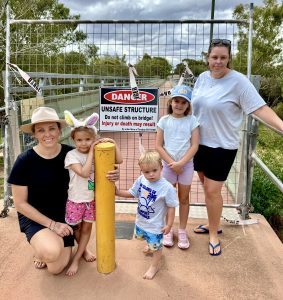
The closure of Slaughterhouse Bridge last month at short notice has highlighted the urgent need for action, while concerns mount over the condition of Dumbarton Bridge and the recent vandalism-related closure of the Newcastle Park footbridge.

Slaughterhouse Bridge, built in 1937 and spanning Toodyay Brook, was the subject of a Main Roads WA report in 2021.

The report revealed the “significant deterioration in the timber elements of the support structure,” and emergency repairs, including acrow props and steel bands, were undertaken in 2023, but the bridge’s condition continued to decline.

Council acknowledged the need to replace Slaughterhouse Bridge as far back as May 2024, however, new funding guidelines from July 2024 require the shire to cover 20% of the bridge replacement costs, with the remaining 80% sourced from State or Federal government grants.

Merry Christmas and a Happy New Year (Dec 2025 edition)

THE TOWN of Toodyay has become an unlikely haven for Christmas enthusiasts, thanks to a unique store dedicated to festive decorations and items almost year-round.
Christmas 360, an enchanted wonderland of lights and colour, has become a major tourist drawcard for the town.

Founded in 2013 by Sean Byron, a former electrician with a lifelong passion for Christmas, the store occupies the space of a former supermarket and has since transformed Toodyay’s retail landscape.

Byron, a long-time resident of Toodyay, initially conceived the idea as a passion project.

However, a turning point came with his partner, Dr Richard Walkey OAM, receiving a diagnosis of gallbladder cancer in November 2012.

Dr Walkey, a beloved local GP for many years, encouraged Byron to pursue his dream.

Although Dr Walkey sadly passed away before witnessing the full extent of the store’s success, his legacy remains a significant part of the shop’s story and Mr Byron named the shop in his honour, “Richard’s Christmas 360” – symbolising Richard’s spirit and the idea of “Christmas all around”.

The name was later shortened to “Christmas 360” as the business grew and developed a broader brand identity, especially once it began attracting statewide visitors and launched its online store.

“Richard’s encouragement was the push I needed,” Mr Byron said.

“He believed in the idea, and I wanted to make it a reality, not just for myself, but for him and for Toodyay.”

Today, “A Toodyay Christmas” offers an extensive array of Christmas decorations, from traditional ornaments and twinkling lights to unique, handcrafted pieces.

The store’s commitment to the festive season extends beyond retail as it actively participates in local events, including Toodyay’s annual Christmas Street party.

More recently, Mr Byron’s partner, Simon Kohler, has become involved in the business, focusing on the wholesale side of the operation.

Together, they are working to expand the store’s reach and bring the joy of Christmas to a wider audience.

The store’s impact on Toodyay has been significant.

Local businesses report an increase in foot traffic and the town’s tourism sector has benefited from the store’s unique appeal.

Visitors flock to Toodyay throughout the year, eager to experience the magic that Christmas 360 offers.

For Perth visitors, Ian and Margaret a visit to Toodyay isn’t complete without dropping into the festive store.

“It’s an experience and it brings a smile to your face,” said Margaret.
Mr Byron leads the store with a commitment to improving the Christmas experience for customers.

His efforts and that of his team have made the Toodyay shop a popular year-round destination in the Wheatbelt.

Being kind makes a difference (Nov 2025 edition)

Sean Hefferon

ROZ Davidson of Toodyay has been awarded the prestigious Badgingarra Roadhouse Local Legend Award at the 7NEWS WA Community Achievement Awards, recognising her tireless work championing equity, kindness, and community support in the region.

Roz is the founder of Toodyay Locals Care (TLC), an organisation she built from the ground up, starting at her own kitchen table, after she, herself a cancer survivor, learned of a U.S. program where people visiting cancer-treatment patients provided companionship.

From that point on TLC’s scope grew to meet other locals needs and with Roz’s determination transformed   into a vital service hub for the Toodyay community.

The winners were announced on Saturday 25th October 2025 during the Awards Gala Presentation Dinner with Noel Brunning from 7NEWS Regional WA Presenter as the MC for the evening. Over 270 guests gathered from across the State to celebrate Western Australia’s community achievers.

Leading a team of over 30 volunteers, Roz oversees a wide range of services provided by TLC including medical transport for those in need, food assistance programs, clothing donations and the provision of emergency supplies to individuals and families facing hardship.

1 2 3 34